Google Reviews and Local SEO: How to Rank Higher on Maps in 2026
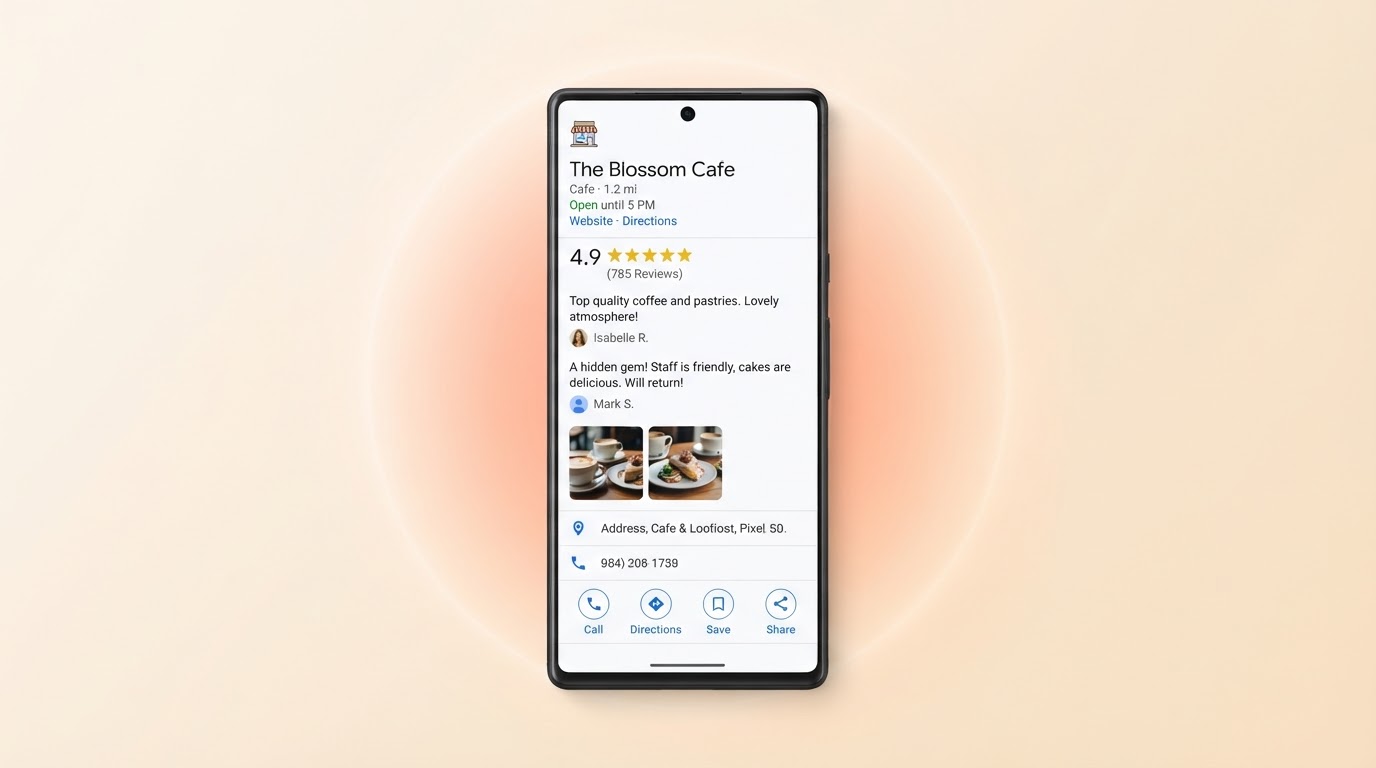
Someone nearby searches for a service you offer. Google shows them three businesses on a map. They glance at the stars, read a few reviews, and call one of them within a minute.
If that isn't you, the reason is often not your prices, your service or even your website. It's your reviews.
In this guide, you'll learn exactly how Google reviews affect your local SEO, how many you really need, and a simple system to collect more of them every month, without breaking Google's rules.
Do Google reviews really affect local SEO?
Yes, and Google says so itself. In its official guidance for business owners, Google explains that local results are based mainly on three factors: relevance, distance and prominence. Reviews sit inside the third one. Google states that review count and review score factor into local ranking, and that more reviews and positive ratings can improve a business's position.
Here's what each factor means for you:
| Factor | What Google looks at | What you can control |
|---|---|---|
| Relevance | How well your profile matches the search | Categories, services, description, website content |
| Distance | How far you are from the person searching | Very little, apart from an accurate address |
| Prominence | How well known and trusted you are | Reviews, links, mentions, activity |
Distance is mostly out of your hands. That makes relevance and prominence the two levers that decide whether you beat a competitor down the street. And of those, reviews are the one you can improve fastest.
Reviews don't just help you rank. They get you chosen.
Ranking is only half the job. Once your business appears, people still have to pick you over the others on the screen.
The numbers are clear. BrightLocal's Local Consumer Review Survey 2026, based on a panel of 1,002 US adults, found that:
- 97% of consumers read reviews before choosing a local business.
- 41% "always" read them, up from 29% just one year earlier.
- 31% will only use a business rated 4.5 stars or higher.
- 85% are more likely to use a business after reading positive reviews.
Put simply, a business with 4.8 stars and a steady flow of recent reviews wins more calls than one with 4.1 stars and nothing new since last year, even when both appear on the same map.
Reviews now matter beyond Google too
There's a newer reason to take reviews seriously: AI assistants.
In the same BrightLocal survey, the share of consumers using AI tools such as ChatGPT or Google's AI Mode to find local businesses jumped from 6% to 45% in a single year. Meanwhile, Google's share fell from 83% to 71%.
When someone asks an AI assistant for "the best physio near me", it has to decide which businesses to recommend. It relies on what it can find about you online, and reviews are one of the clearest public signals of trust. A strong, active review profile helps you show up in traditional search and in AI answers.
How many Google reviews do you need?
There's no magic number. What matters is how you compare with the businesses ranking above you for your main searches.
Try this five-minute check:
- Search for your main service and your town on Google Maps, for example "dentist Sliema".
- Note the rating and review count of the top three results.
- Look at the date of their most recent reviews.
Your target is to match or beat that average, and to keep new reviews coming every month. As a rule of thumb:
- Rating: aim for 4.5 stars or more, the threshold many customers now use.
- Volume: get close to the top three results in your area.
- Recency: new reviews every month. A profile where the latest review is a year old looks inactive, to customers and to Google.
Why most businesses have too few reviews
It's rarely because clients are unhappy. Most businesses have hundreds of satisfied customers and only a few dozen reviews. The reason is almost always the same: nobody asks at the right moment.
A happy client leaves your office, gets back to their day, and forgets. Asking a week later rarely works. Asking once, awkwardly, at the counter doesn't either. Without a system, the review count stays flat while competitors pull ahead.
How to get more Google reviews: a 5-step system
1. Make it effortless
Create your direct review link from your Google Business Profile dashboard. It opens the review window in one tap, with no searching. Shorten it, and turn it into a QR code for your reception desk, receipts or invoices.
2. Ask at the moment of satisfaction
The best time to ask is right after a great experience: when a treatment ends, a job is finished, or a client thanks you. Send the request the same day, while the experience is still fresh.
3. Automate the request
Relying on staff to remember doesn't scale. An automatic text or email sent after each appointment, with your review link, is the single biggest change most businesses can make. It turns a random trickle into a steady flow.
4. Ask everyone, the same way
Don't only ask the clients you expect to leave five stars. Filtering who receives a request, known as "review gating", goes against Google's policies. Asking every client the same way is both compliant and more credible, because a mix of reviews reads as genuine.
5. Keep it simple and personal
A short, friendly message works best:
Hi Maria, thank you for coming in today. If you have a minute, a quick Google review would really help us. It only takes a tap: [link]
Reply to every review, good or bad
Replies show future customers that a real person cares. They also give you a chance to naturally mention your services and area, which helps Google understand what you do.
For a positive review: thank the person by name, mention what they appreciated, and keep it human. Avoid pasting the same sentence under every review, since customers notice copy-paste replies.
For a negative review: stay calm, reply quickly, and never argue in public. Acknowledge the experience, apologise where appropriate, and offer to continue the conversation privately. A thoughtful reply to a bad review often builds more trust than ten generic thank-yous.
Mistakes that can hurt your profile
Some shortcuts do more harm than good:
- Buying reviews or posting fake ones. Google removes them and can restrict your profile. In the European Union, fake reviews are also banned under consumer protection law, and in the United States the FTC's rule on consumer reviews targets fake and misleading reviews.
- Offering rewards in exchange for reviews. Discounts or gifts for a review are against Google's policies.
- Asking for all your reviews in one week. A sudden burst followed by silence looks unnatural. Consistency beats spikes.
- Ignoring negative reviews. Silence reads as indifference.
Reviews work best as part of a system
Reviews are powerful, but they don't work alone. They bring people to your profile. Your Google Business Profile needs to be complete and active. And your website has to convince visitors once they click.
A business with great reviews that sends visitors to a slow, dated website still loses clients at the last step. The businesses that win locally treat these three things as one system: a strong website, an optimised Google profile, and a steady flow of reviews.
Where does your business stand today?
If you're not sure how your reviews, Google profile and website compare with your competitors, start with a clear picture.
Our free audit shows your local SEO score, where you rank on Google Maps street by street, how visible you are in AI search, and what to fix first. No subscription, no obligation.
Get my free auditFrequently asked questions
Yes. Google confirms that review count and review score are part of how it ranks local businesses. Reviews also increase the chance that people click and call once your business appears.
There's no fixed number. Compare yourself with the top three businesses on Google Maps for your main search in your area, aim to match their volume, keep a rating of 4.5 or more, and collect new reviews every month.
Send an automatic request with your direct review link right after each appointment or job. Asking every client at the moment they're most satisfied is the fastest sustainable way to grow your reviews.
No. Google's policies prohibit offering incentives for reviews. You can ask every customer for honest feedback, but you can't reward them for leaving a review.
Yes, always. Reply quickly, calmly and professionally, acknowledge the issue, and offer to resolve it privately. Future customers judge how you handle criticism as much as the review itself.
They still count toward your total, but recent reviews carry more weight with customers, who want to know what your business is like today. A regular flow of new reviews keeps your profile credible.